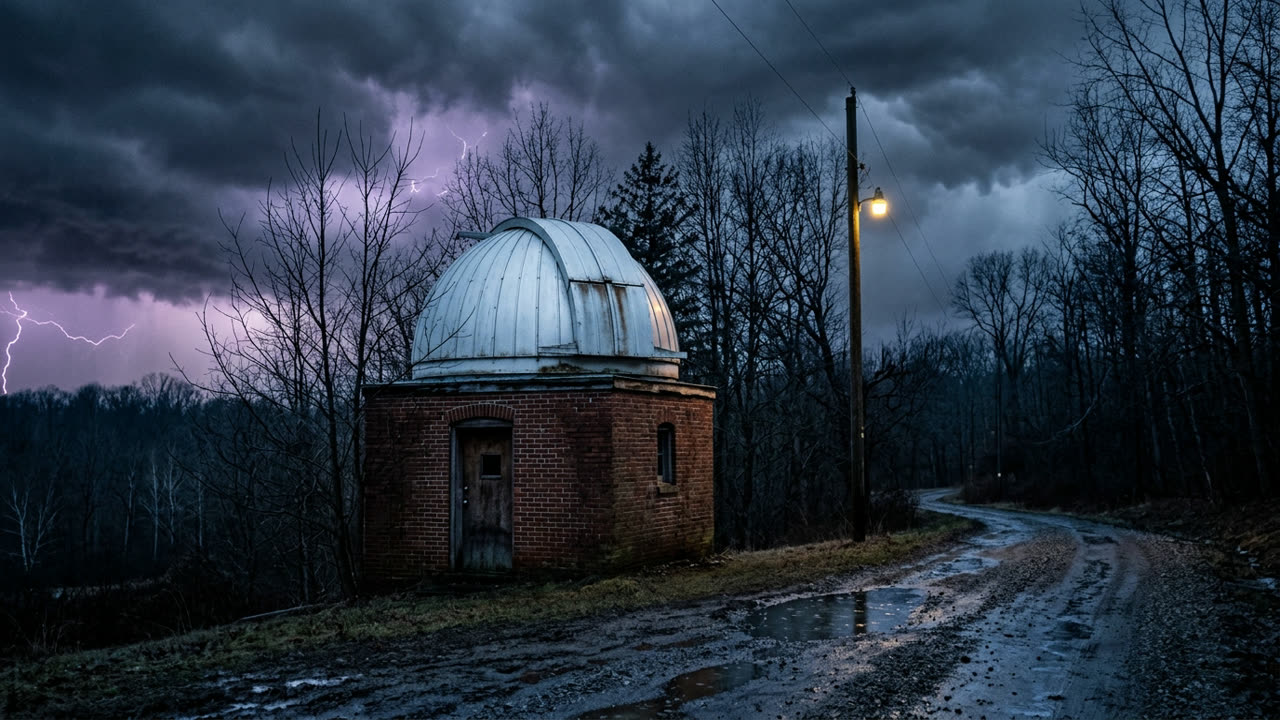
Method and baseline
You are the analyst of record. Four people collected this evidence and you were not with them. Nothing in the file can be asked a question, so the record is the only witness.
Feelings are logged, not weighed.
That is MIPRO policy. If someone reports an impression of a room, the report goes into the log with the time it was said, and stays out of the analysis.
| Instrument | Position |
|---|---|
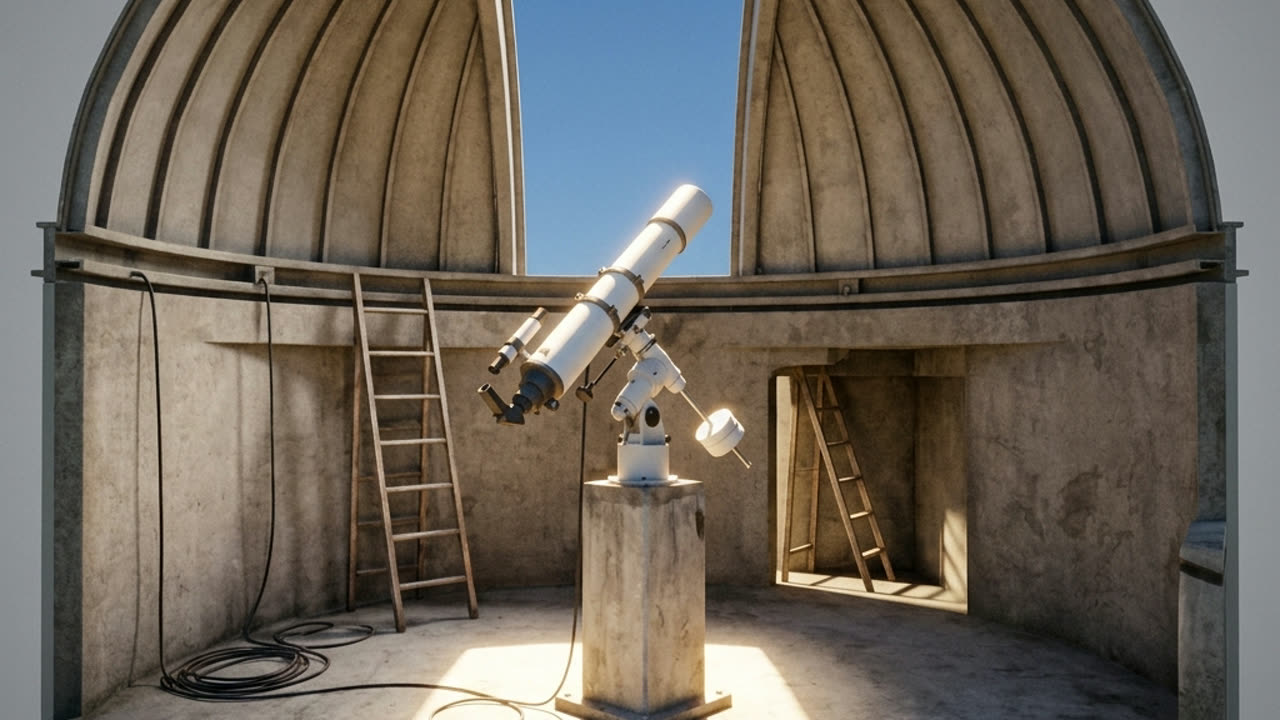
| Camera A | North wall of the dome room, wide |
| Camera B | South door, wide |
| Camera C | Telescope pier, close |
| Two audio recorders | Dome floor and warm room |
| EMF meter, infrasound logger, thermometer | Dome floor |
| Camera D | Review room, left recording per protocol |
On September 12 the team ran a daytime control: every instrument recording the empty dome for six hours in full light. The log for that day is blank. The control is the reason anything that follows counts as a change.
| Name | Role | In |
|---|---|---|
| R. Vance | Lead, analysis | 21:14 |
| T. Kowalski | Audio | 21:20 |
| D. Reyes | Video | 21:31 |
| J. Marsh | EMF and environment | 21:38 |
At the gas station on County Road 4 the clerk volunteered that the dome used to open by itself. Vance logged it as an anecdote: one person, no date, secondhand.
Vance, margin: She also swore the coffee was fresh. An anecdote gets logged and nothing more.
The refractor's objective lens was capped, and the cap was taped down with black tape. A card under the tape, in a hand nobody has identified, reads: Leave it covered. 1994.
The cap, the tape and the card were photographed in place and logged as objects.
Night session
The session ran from 22:00 on September 13 to 04:00. The breaker panel was switched off at 22:05 and stayed off, so the dome motor had no power all night. Cameras A, B and C ran continuously.
At 23:30, ninety minutes in, Reyes removed the tape and the cap from the objective lens. It was logged as a control before anyone had looked at the footage: an uncovered lens is the one optical surface in the room that can throw a reflection, and it is easier to rule out open than to argue about shut.
Subjective: excluded from analysis
01:10, J. Marsh: I felt like someone was standing behind me.
Logged at 01:12. Not used in any test.
The dome's azimuth encoder, which reports where the slit is pointing, recorded movement all night. The motor had no power. Wind at the site stayed at 2 km/h or below on Marsh's anemometer.
| Time | Reading |
|---|---|
| 00:42 | 118.0 degrees |
| 01:55 | 131.4 degrees |
| 03:07 | 146.9 degrees |
No natural cause was found that night, and none was assumed.
| Date | Observer | Present | Note |
|---|---|---|---|
| Oct 2, 1994 | M. Ortiz | 4 | Seeing 3 of 5. Closed dome 23:40. |
| Oct 7, 1994 | P. Lindqvist | 4 | Transparency fair. Closed dome 22:55. |
| Oct 9, 1994 | D. Haskell | 4 | Closed dome 23:10. Lens capped. |
Review, September 20
Per protocol Camera D was left recording in the review room, the room you are in. Reyes reviewed Camera B first. At frame 11,402, timestamp 01:44:16, there is a figure at the back of the dome room.
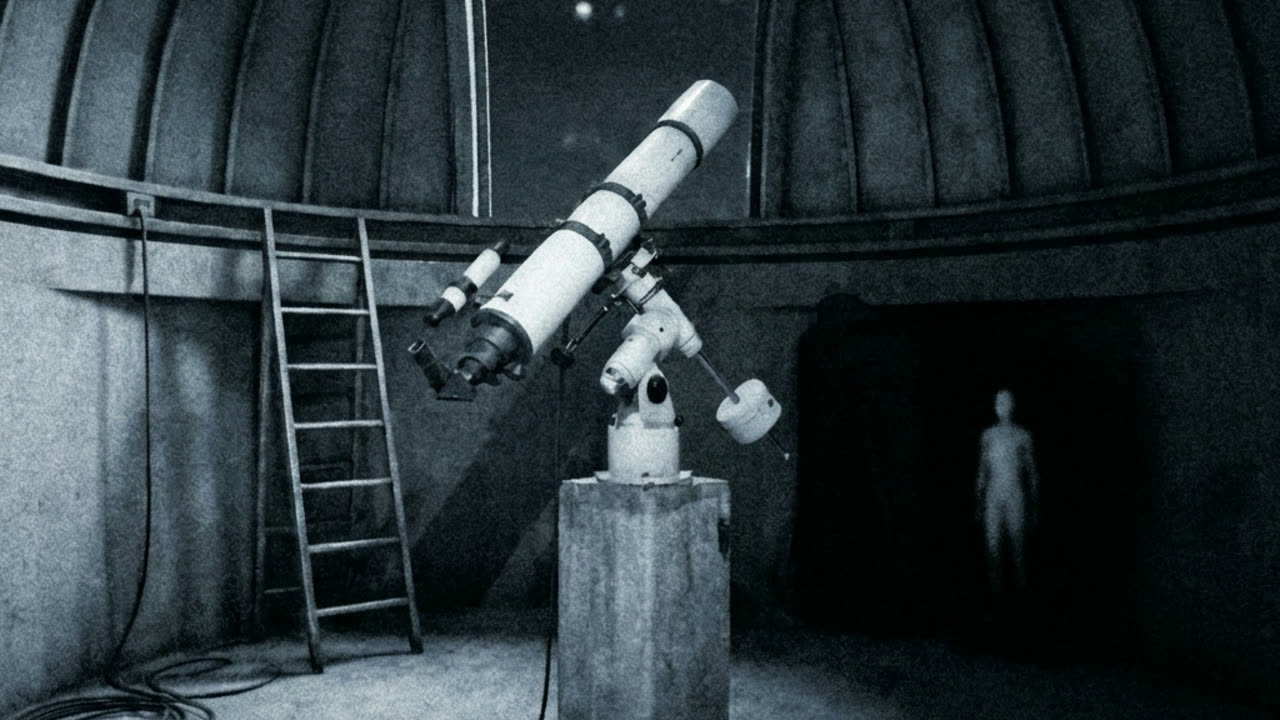
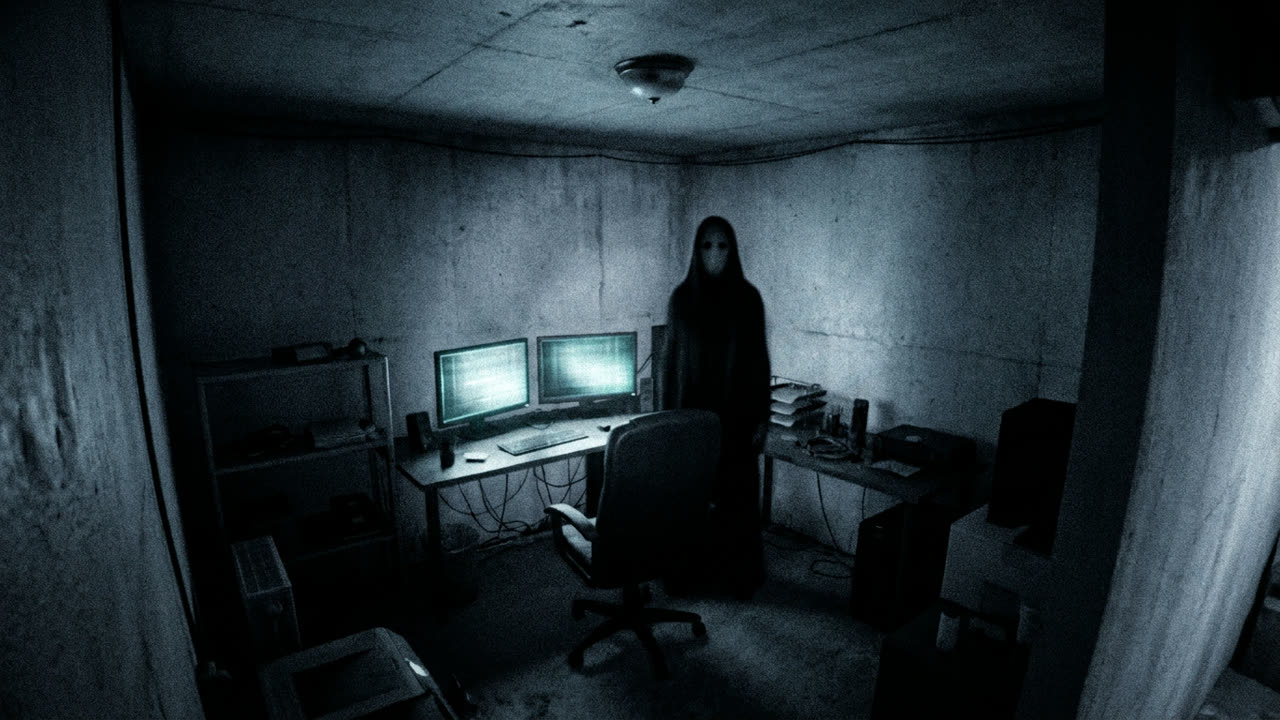
The sign-in sheet says four people were in the building. Camera D now shows a figure in this room as well. The reading in the instrument rack is its estimated distance from your station: 7.2 m. It was not there when the recording started. It has not moved while you read this paragraph.
Vance, margin: Reyes flagged frame 11,402 on Friday and I told her to log it and go home. That was a scheduling error, not a method error.
What you can do is on the evidence board. Each test removes explanations. Each test also alters the footage it examines.
Evidence board
Seven tests are open to you. Every test costs evidence integrity, because examining footage alters it, and every test costs report time, which is the time Camera D keeps running. File the report when you have enough. Below 25 percent integrity the footage can no longer be tested.
Run too few tests and the report is unresolved. Run too many and there is no record left to report on.
Raw sensor re-extraction
Observation. Frame 11,402 is a compressed video frame. It has been through the camera's encoder, which smooths detail and invents none, but which can turn blocks of noise into shapes.
Hypotheses. H1, pareidolia: the figure is a pattern assembled from noise. H2, compression artifact: the encoder produced the shape.
Test. Go back to the raw sensor files, from before the encoder, and look for the same shape in the same place.
Raw sensor re-extraction: Camera B
Camera B's raw file at 01:44:16 holds the shape before the encoder touched it: a vertical region about 40 pixels wide, 11 percent brighter than the wall behind it. Noise does not repeat. The same shape sits in the same place in 60 consecutive frames.
H1 and H2 are struck, on one camera's evidence.
Vance, margin: One camera is one camera. Strike it and write “single source” next to it.
Raw sensor re-extraction: all three cameras
All three raw files at 01:44:16. Camera A sees the figure from the north wall, Camera C from the pier, Camera B from the door. The three views differ by the parallax of an object about 7 m away, to within 4 percent. Three separate sensors do not share an encoder fault.
H1 and H2 are struck, and the result is firm.
Vance, margin: Each camera logged the checksum of its raw file when the session ended. You can compare them again on the board. Be aware of what that costs.
Control camera comparison
Observation. A fault in a camera shows up on that camera when nothing is in the room: in the daytime control, or as a fixed pattern in its dark frames.
Hypotheses. H3, sensor or lens fault: something wrong with a camera produces the figure.
Test. Compare the night footage with the September 12 daytime control and with each camera's dark-frame noise.
Control comparison: Camera B
Camera B's control footage is clean: no fixed pattern and no hot pixels near the figure's position. The figure is not in any of the 40 daytime frames compared.
H3 is struck.
Control comparison: all three cameras
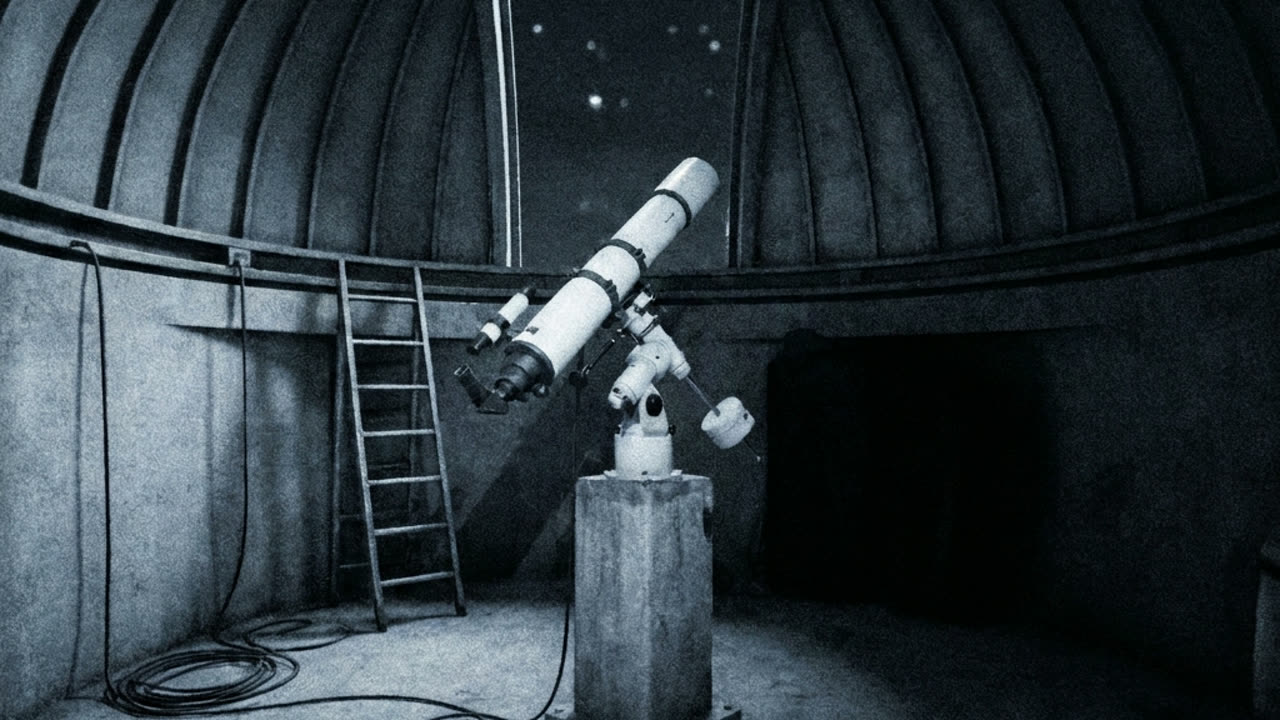
All three cameras are clean against the control and against dark-frame subtraction. The three noise maps below are flat: no fixed pattern, no hot pixels, nothing near the figure's position on any sensor.
H3 is struck, and the result is firm.
Headcount and sight-lines
Observation. A person not on the sign-in sheet is unlikely. A person who was on it, standing in the wrong place, is not. A reflection is cheap to rule out: it needs a bright surface, a source and a line between them.
Hypotheses. H4, teammate or reflection: the figure is one of the four, seen directly or reflected in the refractor's optics or a window.
Test. Place all four people at 01:44:16 from the other cameras and the audio log, then draw the sight-lines.
Headcount and sight-lines
At 01:44:16, Reyes is on Camera A at the north wall. Marsh is on Cameras A and C beside the EMF meter. Vance is on Camera C at the pier. Kowalski is in the warm room: his recorder has his voice, and that room has no line of sight into the dome.
The refractor's objective was uncovered at 23:30 and points at the slit. Nothing on the back wall can reflect into Camera B from it, and the dome has no windows.
H4 is struck.
Vance, margin: A reflection would have been the cheaper result to write up.
Environmental logs
Observation. If something in the building produced the figure, it should leave a trace elsewhere: a field, a vibration or a change in temperature.
Hypotheses. H5, environmental: wiring, infrasound from wind or machinery, or a heat source produced the effect.
Test. Check every environmental log at each of the nine appearances. This test reads logs and not footage, so it does not alter the footage.
Environmental logs
| Instrument | Reading | Daytime control |
|---|---|---|
| Infrasound | under 0.1 Pa | under 0.1 Pa |
| EMF | 0.3 mG, flat | 0.3 mG |
| Temperature | 11.2 degrees C, drift under 0.1 | not applicable |
The breakers were off. Nothing in the building was running. H5 is struck.
Vance, margin: The logs say the building was asleep.
Positional analysis
Observation. The figure appears in nine frames across six hours. If it is moving, its distance can be measured.
Hypotheses. None are left to test here. This test measures.
Test. Fit the figure's distance from Camera A against time.
Positional analysis: Camera B
Nine frames. The figure starts at 7.2 m at 95 minutes into the session and ends at 0.9 m at 343 minutes. It only moves closer. The first frame is five minutes after the lens was uncovered at 90 minutes. That is logged and not interpreted.
Camera D reads 7.2 m. Its first reading today was 7.2 m. Same start, same direction.
Positional analysis: all three cameras
Nine frames on three cameras. The figure starts at 7.2 m at 95 minutes into the session and ends at 0.9 m at 343 minutes. The straight-line fit has an R-squared of 0.98. The first frame is five minutes after the lens was uncovered at 90 minutes. That is logged and not interpreted.
The figure appears on a camera only while that camera is recording. Camera C lost power from 02:51 to 03:02: it has no record of the figure for those eleven minutes, and Cameras A and B recorded it closing by 0.6 m over the same eleven.
Camera D reads 7.2 m. Its first reading today was 7.2 m. Same start, same direction. The result is firm.
Audio analysis
Observation. At 02:30 Kowalski ran a protocol test: three knocks on the pier, then listen. Recorder 1 on the dome floor and Recorder 2 in the warm room were both running.
Hypotheses. None are left to test here. This test measures.
Test. Compare the knocks made with the knocks recorded, and look for structure in the audio.
Audio analysis: spot check
Three knocks were made. Four are on the recording. The fourth arrives after a pause and is at the same level as the others. Nobody was knocking.
Audio analysis: full file
Three knocks were made. Four are on the recording, and the fourth was not made by anyone. Cross-correlating the whole file puts the room's reply 2.4 seconds before the knock it answers. In the record, the effect comes first.
Activity on Recorder 2 happens only in the silent gaps between sounds. A fifth breathing cadence is present at 7 breaths a minute. It matches none of the four people: Vance 14, Kowalski 16, Reyes 12, Marsh 18. The result is firm.
Plate solve and geometry
Observation. The slit camera records the sky, and a sky can be solved: stars in the frame can be matched to a catalogue to say where and when the camera was looking. The dome can be measured too: a laser gives its inside width and a tape its outside.
Hypotheses. None are left to test here. This test measures.
Test. Plate-solve the slit frame at 02:00 and measure the dome inside and outside.
Plate solve and geometry: one pass
The slit frame holds 212 stars. None match a catalogue star at the current epoch. The dome measures 7.4 m across inside and 6.1 m across outside. The inside is wider than the outside by 1.3 m, and the wall has thickness, so the inside should be narrower.
Plate solve and geometry: every epoch
| Measurement | Result |
|---|---|
| Plate solve, 1900 to 2100 | 0 of 212 stars matched at any epoch |
| Dome inside, three laser readings | 7.4 m, 7.4 m, 7.4 m |
| Dome outside, tape | 6.1 m |
| Spectrometer on the slit light | line at 538.6 nm, catalogue tolerance 0.5 nm, no entry matches |
The inside of the dome is wider than the outside by 1.3 m. The result is firm.
Checksum re-run
The footage was checked against the checksum logged when the session ended. The two do not match, and every re-run changes the file a little more. Checking the evidence is an act, and it is logged as one.
| Logged | 3f9a1c7e5b02d846 |
|---|---|
| Now | not yet run |
Re-cap the objective lens
This puts the lens back in the configuration the logs describe before 23:30, as a documented control. It ends the review. You cannot reopen the board afterwards.
File the report
The report will describe what has been tested so far and nothing else. It ends the review. You cannot reopen the board afterwards.
Filed: no explanations remaining
You file the report with every natural explanation struck from the ledger. Pareidolia, the encoder, the cameras, the four people, the optics, the building: each was proposed, each was tested, each failed.
What is left is a figure in nine frames that closes along a straight line, and a reading on a camera in this room that is following the same line at the same rate.
| R. Vance | Signed |
| T. Kowalski | Signed |
| D. Reyes | Signed |
| J. Marsh | Signed |
| Analyst of record, this session | Signed |
Extrapolated distance at time of reading: 0.0 m.
| Date | |
|---|---|
| Observer | |
| Note | At last, a room with someone in it. |
Filed: the record does not exist
You file the report. The footage you tested has been tested past use. The checksum of the file as it stands now matches neither the logged value nor any earlier run, and the footage can no longer be opened to check.
The report survives. The record it describes does not. Whatever the footage once showed cannot be shown again, and nobody can prove it ever did.
Camera D has no such problem. It reads 0.0 m and it is still recording.
Vance, margin: We tested it to dust. That is also a result.
Filed: lens re-capped
You put the objective lens back in the configuration the logs describe before 23:30: cap on, tape down, card under the tape. It is a control, and it is logged as one.
Three more frames from Camera D, twenty seconds apart. The figure reads 0.0 m in all three. It has stopped closing.
A control with a sample of one is a control and not a result, and it is written up as exactly that. The report is filed with its questions open and one recommendation: the cap stays on.
This page is intentionally blank.
Filed: unresolved
You file with explanations still on the list. The report says what was tested and what was not, and it says so plainly.
The figure on Camera D has not stopped closing. Nothing in the file says that it will.
Extrapolated distance at time of reading: 0.0 m.
Contact
Camera D reads 0.0 m. There is no report to file: the reading reached zero before you could.
The recording continues.
Extrapolated distance at time of reading: 0.0 m.
| Revision | When | By |
|---|---|---|
| 1 | September 20, 08:02 | Analyst of record |
Case closed.
Case closed. This was fiction. Your device is fine.